
Fibermaxxing is everywhere. I'm a year late (not technically). Let's talk about it anyway.
 Priyanka Soni
MSc Human Nutrition · Registered Associate Nutritionist (AfN, UK)
Priyanka Soni
MSc Human Nutrition · Registered Associate Nutritionist (AfN, UK)
30 Sep 2026 · 6 min read
So there's this TikTok trend called fibermaxxing, and I found out about it the way most people my age find out anything now. Way too late, and way too excited about it.
It started in July 2025. That's over a year ago. In internet years that's practically carbon-dated. I'm the guy who showed up to the office in 2019 with a "Live, Laugh, Love" mug, except this time the mug is made of oat bran. But being late has one upside nobody talks about: you get to see whether the thing actually held up, instead of just reacting to it while it's still hot. And fibermaxxing held up. That's the part that genuinely surprised me.
Let me back up.
What Actually Happened in July 2025
Nutrition trends rarely have a clean origin story, and this one doesn't either. But the moment it broke into the mainstream is easy enough to point to. European outlets were running "should we all be doing this" explainers by mid-July 2025. American food and health sites picked it up within a month. The pitch was simple. Eat fiber-rich foods on purpose, beans, oats, chia, lentils, fruit, vegetables, and start paying attention to how much you're actually getting, the same way people once obsessed over protein grams.
What made this one different is that dietitians didn't roll their eyes. They joined in. That basically never happens with a TikTok wellness trend. Normally the professional response is a polite sigh followed by a correction video. This time registered dietitians were the ones sharing it. In hindsight, that should have told me something a full year before I bothered to notice.
Why It Actually Had Legs
Most trends fizzle because the advice underneath was thin to begin with. This one didn't fizzle, because the advice underneath was solid, we just weren't listening to it when it came from our doctors instead of an app with a "For You" page.
In the US, the standard benchmark, based on the Institute of Medicine's Adequate Intake values and still the backbone of USDA guidance, is about 25 grams a day for women and 38 for men under 50 (Institute of Medicine, 2005). A NHANES analysis covering 2013 to 2018 found that only 7.4% of American adults actually hit that number (Miketinas et al., 2021). Seven percent. That's not a shortfall, that's a country running on fumes and calling it a personality.
That's not a shortfall, that's a country running on fumes and calling it a personality.
The UK isn't doing much better. NHS and SACN guidance calls for 30 grams a day for adults 16 and older (Scientific Advisory Committee on Nutrition, 2015). The average adult gets around 16 to 17 grams, and only about 4% of UK adults meet the target (Office for Health Improvement and Disparities, 2025). Four percent is the kind of number you'd expect from a pop quiz nobody studied for.
And this isn't just a Western thing, which somehow makes it worse. The 2017 Global Burden of Disease study looked at 195 countries (GBD 2017 Diet Collaborators, 2019) and found fiber intake below the WHO and EFSA benchmark of 25g a day (EFSA Panel on Dietetic Products, Nutrition, and Allergies, 2010; World Health Organization, 2023) in every single region evaluated, dropping under 10g a day in some of them. Here's the spread, country by country:
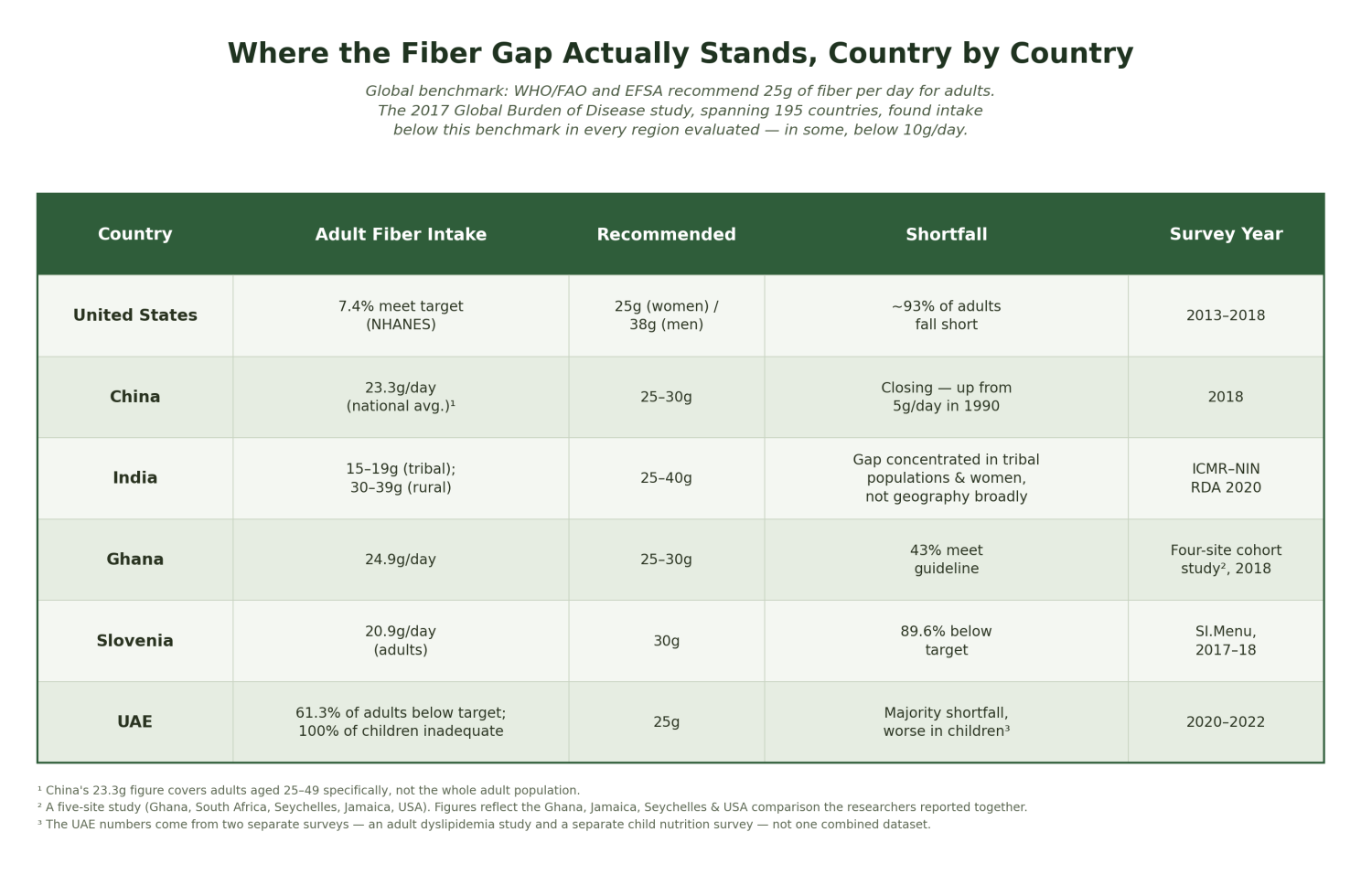
When a wellness trend's whole thesis boils down to "you are almost certainly deficient in this, no matter where you live," that's not really a trend anymore. That's just a diagnosis that happened to arrive with a catchy name.
The Science That Actually Aged Well
A year later, most of the core claims still check out.
Fiber is genuinely tied to lower risk of heart disease, type 2 diabetes and colorectal cancer. A major review of the evidence in The Lancet found the biggest risk reductions clustering around 25 to 29 grams a day (Reynolds et al., 2019), which lines up almost exactly with the official targets. Somewhere a dietitian is saying "I told you so" and honestly, they earned it.
The gut health piece holds up too. Fiber that survives the small intestine gets fermented by bacteria in the colon into short chain fatty acids like acetate, propionate and butyrate (Koh et al., 2016). These are linked to lower inflammation and a more diverse microbiome, and no, I'm not just saying that because it sounds impressive in a meeting.
Then there's the GLP-1 connection, which is the part I'd keep an eyebrow raised at. Those same short chain fatty acids can nudge the gut into releasing its own GLP-1 (Tolhurst et al., 2012), the same hormone that drugs like Ozempic target. That mechanism is real. What's not real, or at least not backed by solid human data on how big the effect actually is, is the claim that fibermaxxing is basically Ozempic from a salad. A year of hype hasn't produced better evidence for that one. It's just produced more confident people saying it, which is not the same thing, and is honestly a little concerning.
Where a Year of Momentum Went Wrong
By early 2026 the trend had drifted a bit. What started as "add more fiber rich foods to your day" turned, for a loud chunk of creators, into a race to hit 40 or 50 grams like it was a personal best on a treadmill. That's exactly where the real downsides show up. Ramping up too fast causes bloating, gas and cramping, and for people with IBS or SIBO it can genuinely backfire. A few dietitians spent most of 2025 gently, and then not so gently, warning people about this.
The good news is the trend seems to be correcting itself. Mintel's 2026 food trend report (Mintel, 2025) describes a shift away from "maxxing" and toward "fiber diversity," the idea that different fibers feed different gut bacteria, so a supplement shake and a bowl of lentils aren't interchangeable just because the label says the same number of grams. It's rare for a wellness fad to self correct like that. Usually they just quietly disappear and get replaced by something involving cottage cheese.
What Actually Held Up
Take away the escalation and the "maxxing" branding, and what's left is advice that was true before the hashtag and is still true now.
Add fiber gradually. Beans in the soup, oats instead of cereal, fruit with the skin left on. Prioritize whole foods over powders and bars, since variety seems to matter more than any single high fiber hero ingredient. Drink water, because fiber without water is just a different problem wearing a costume. And don't expect any of this to replace medication, no matter how confidently your algorithm implies it will.
So here's the verdict. Almost everyone, in almost every country, is short on fiber. It got a little carried away with the cure, because more is not always cool, and your gut will absolutely let you know about it. Still, that's a better track record than most things that trend on TikTok. And a far better one than my "Live, Laugh, Love" mug ever managed.
Glossary
14 terms
- Adequate Intake (AI)
- A recommended daily amount set when there isn't enough evidence for a full requirement, based on what healthy people typically eat. ↑ Back to text
- EFSA
- The European Food Safety Authority, the EU body that gives scientific advice on food and nutrition, including daily intake recommendations. ↑ Back to text
- Fermentation
- The breakdown of fiber by bacteria in the colon, which produces gas and short chain fatty acids. ↑ Back to text
- Fiber
- Carbohydrate from plant foods that isn't digested in the small intestine, so it reaches the colon largely intact. ↑ Back to text
- Fiber diversity
- Eating fiber from a range of foods, because different types of fiber feed different gut bacteria. ↑ Back to text
- Global Burden of Disease (GBD) study
- A large international research programme that estimates how much illness and death is linked to diseases and risk factors, including diet, in each country. ↑ Back to text
- GLP-1
- A gut hormone released after eating that slows stomach emptying and helps regulate appetite and blood sugar. ↑ Back to text
- IBS
- Irritable bowel syndrome, a common long-term gut condition that causes pain, bloating and changes in bowel habit. ↑ Back to text
- Microbiome
- The community of microorganisms living in the gut, together with their genes. ↑ Back to text
- NHANES
- The National Health and Nutrition Examination Survey, a US programme that combines interviews and physical examinations to track the population's health and diet. ↑ Back to text
- Ozempic
- A brand of semaglutide, a prescription medicine that mimics GLP-1 and is used to treat type 2 diabetes. ↑ Back to text
- SACN
- The Scientific Advisory Committee on Nutrition, the expert group that advises the UK government on diet and health. ↑ Back to text
- Short chain fatty acids
- Acetate, propionate and butyrate, the main compounds gut bacteria produce when they ferment fiber. ↑ Back to text
- SIBO
- Small intestinal bacterial overgrowth, a condition in which unusually large numbers of bacteria grow in the small intestine. ↑ Back to text
References
- EFSA Panel on Dietetic Products, Nutrition, and Allergies. (2010). Scientific opinion on dietary reference values for carbohydrates and dietary fibre. EFSA Journal, 8(3), Article 1462. https://doi.org/10.2903/j.efsa.2010.1462
- GBD 2017 Diet Collaborators. (2019). Health effects of dietary risks in 195 countries, 1990–2017: A systematic analysis for the Global Burden of Disease Study 2017. The Lancet, 393(10184), 1958–1972. https://doi.org/10.1016/S0140-6736(19)30041-8
- Institute of Medicine. (2005). Dietary reference intakes for energy, carbohydrate, fiber, fat, fatty acids, cholesterol, protein, and amino acids. The National Academies Press. https://doi.org/10.17226/10490
- Koh, A., De Vadder, F., Kovatcheva-Datchary, P., & Bäckhed, F. (2016). From dietary fiber to host physiology: Short-chain fatty acids as key bacterial metabolites. Cell, 165(6), 1332–1345. https://doi.org/10.1016/j.cell.2016.05.041
- Miketinas, D., Tucker, W., Patterson, M., & Douglas, C. (2021). Usual dietary fiber intake in US adults with diabetes: NHANES 2013–2018. Current Developments in Nutrition, 5(Suppl. 2), 1061. https://doi.org/10.1093/cdn/nzab053_054
- Mintel. (2025). 2026 global food & drink predictions. https://www.mintel.com/insights/food-and-drink/global-food-and-drink-trends/
- Office for Health Improvement and Disparities. (2025). National Diet and Nutrition Survey 2019 to 2023. GOV.UK. https://www.gov.uk/government/statistics/national-diet-and-nutrition-survey-2019-to-2023
- Reynolds, A., Mann, J., Cummings, J., Winter, N., Mete, E., & Te Morenga, L. (2019). Carbohydrate quality and human health: A series of systematic reviews and meta-analyses. The Lancet, 393(10170), 434–445. https://doi.org/10.1016/S0140-6736(18)31809-9
- Scientific Advisory Committee on Nutrition. (2015). Carbohydrates and health. The Stationery Office.
- Tolhurst, G., Heffron, H., Lam, Y. S., Parker, H. E., Habib, A. M., Diakogiannaki, E., Cameron, J., Grosse, J., Reimann, F., & Gribble, F. M. (2012). Short-chain fatty acids stimulate glucagon-like peptide-1 secretion via the G-protein–coupled receptor FFAR2. Diabetes, 61(2), 364–371. https://doi.org/10.2337/db11-1019
- World Health Organization. (2023). Carbohydrate intake for adults and children: WHO guideline. https://www.who.int/publications/i/item/9789240073593
Content on Nutri-Verse is general information, not personal medical or dietary advice. Health disclaimer